

Rabbit vs. Hare: What’s the Difference?
At first glance, rabbits and hares look almost identical. They both belong to the order Lagomorpha, feature long ears, twitchy noses, and powerful hind legs built for bounding across fields. Because of these striking similarities, the two names are frequently used interchangeably.
But rabbits and hares are adapted to very different survival strategies. One relies on a hidden underground community and safety in numbers, while the other depends on raw speed, endurance, and open country. Their newborns, nesting habits, and physical builds all reveal fundamental differences.
Quick Comparison
| Feature | Rabbit | Hare |
| Habitat | Underground burrows, meadows, woodlands | Open fields, grasslands, tundra |
| Social Structure | Highly social; live in colonies (warrens) | Solitary; pair up only to mate |
| Baby State (At Birth) | Altricial: blind, hairless, and helpless | Precocial: fully furred, open eyes, can hop |
| Nesting | Underground nests lined with mother’s fur | Shallow surface depression (form) in open grass |
| Body Shape | Compact, shorter legs | Lean, longer legs and larger feet |
| Ears | Shorter, often with dark tips | Longer, often tipped with black markings |
| Defense Strategy | Hide in burrows or freeze | Outrun predators with extreme speed |
The Biggest Difference: How They Live and Breed
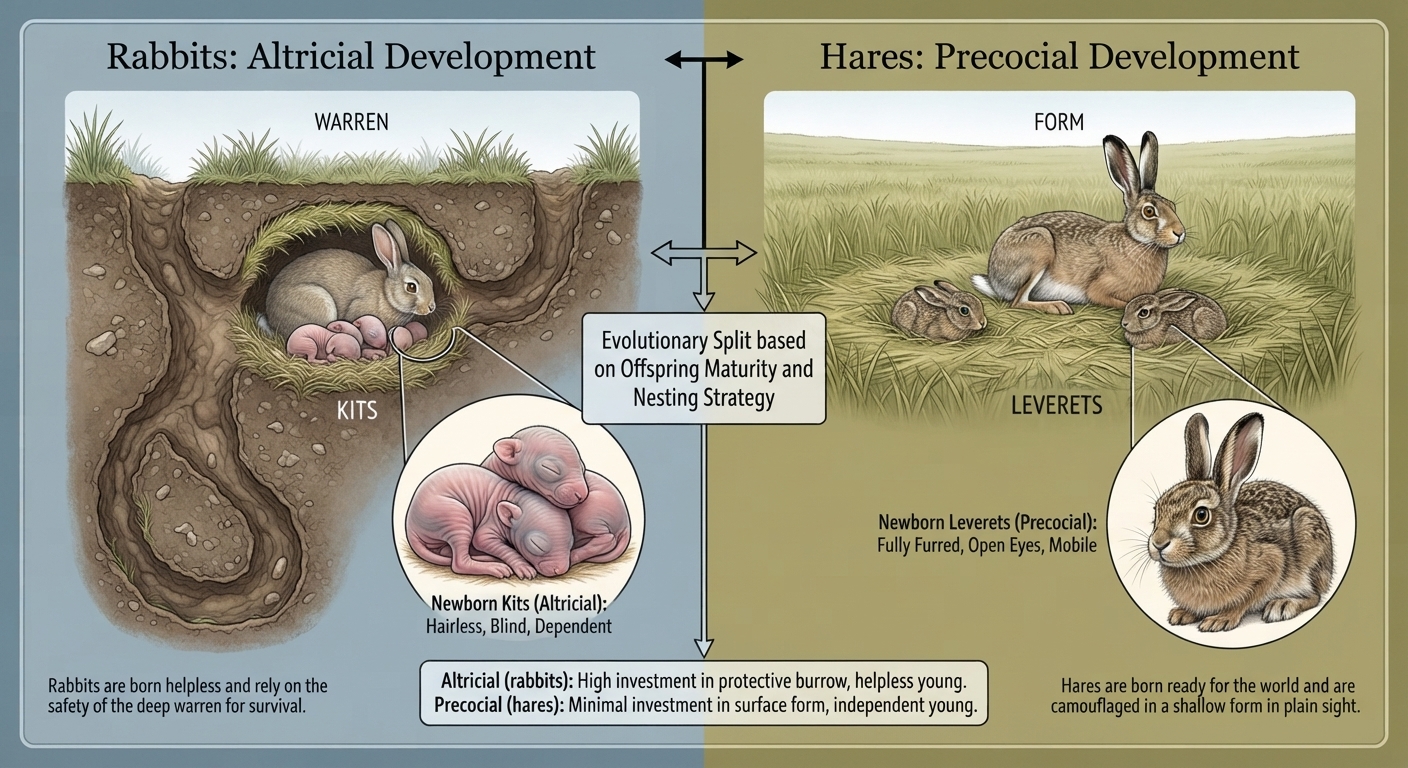
The easiest way to understand the evolutionary split between rabbits and hares is to look at how they raise their young.
Rabbits are altricial. When baby rabbits (kits) are born, they are completely blind, hairless, and entirely dependent on their mother. To protect them, female rabbits dig deep underground burrows called warrens, lining the nest with soft grass and fur plucked from their own chests.
Hares are precocial. When baby hares (leverets) are born, they emerge fully furred with their eyes wide open and can hop around within minutes. Because they are ready to face the world immediately, hares do not build burrows. Instead, the mother gives birth in a shallow depression in the ground called a “form,” leaving the leverets hidden in plain sight.
Body Shape: Compact vs. Built for Speed
Their physical builds reflect their primary methods of escaping predators.
Rabbit Body
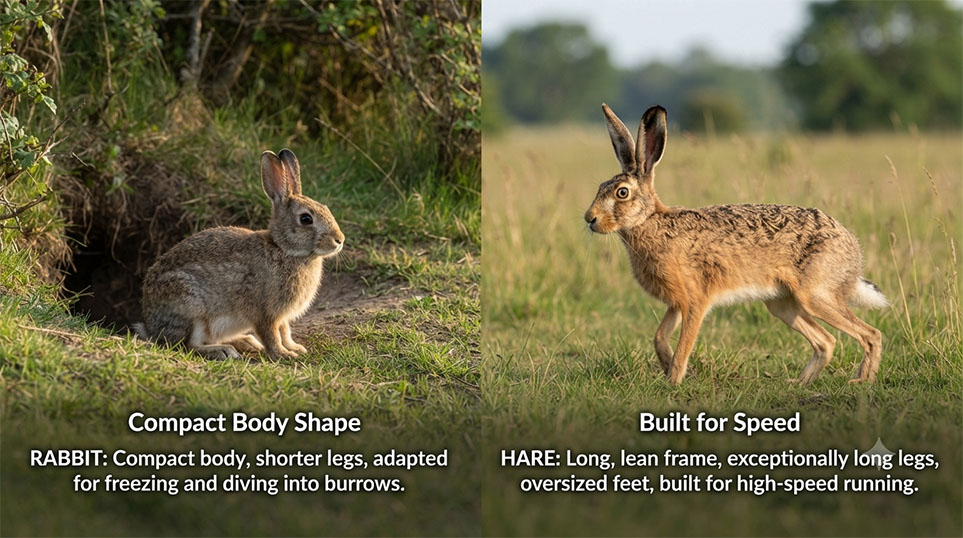
Rabbits have shorter, more compact bodies. While they are quick, they aren’t built for prolonged high-speed chases across flat ground. When a predator approaches, a rabbit’s first instinct is to dive into the safety of a nearby burrow or freeze against the brush.
Hare Body
Hares possess longer, leaner frames with exceptionally long legs and oversized feet. This athletic build allows them to reach staggering speeds—some species can sprint up to 45 miles per hour. Instead of hiding underground, a startled hare will rely on its incredible speed and erratic, zig-zagging leaps to outrun a predator in the open.
Ears and Coloration
You can often tell the two apart by looking at their heads.
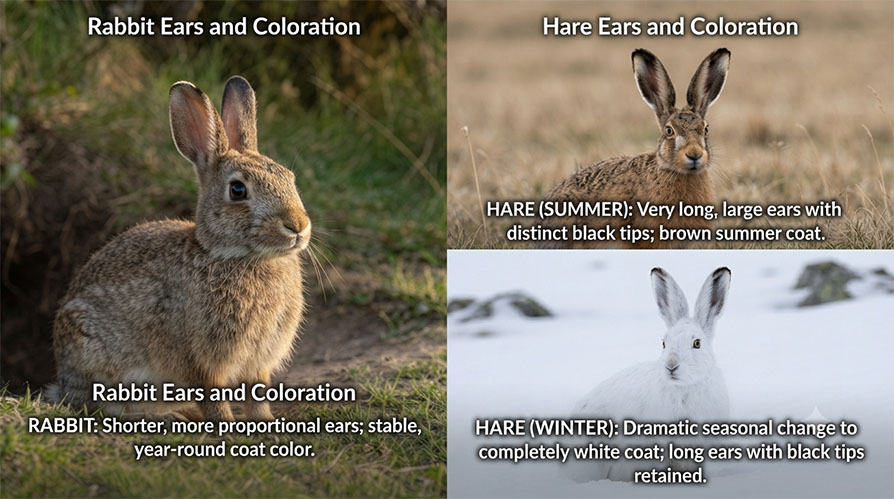
- Ears: Hares generally have noticeably longer, larger ears, often tipped with distinctive black patches. These help them regulate body temperature in open environments and detect distant sounds. Rabbit ears are shorter and more proportional to their heads.
- Coat Changes: Some hares (like the Snowshoe Hare) undergo a dramatic seasonal transformation, turning completely white in the winter for camouflage in the snow. Rabbits generally maintain similar fur colors year-round, though their coats may thicken.
Are Hares Just “Giant Rabbits”?
This is one of the most common misconceptions.
While they look like close cousins, rabbits and hares are actually quite distinct evolutionarily. They belong to different genera and cannot interbreed. In fact, hares diverged from rabbits millions of years ago, adapting specifically to life on open plains where underground burrows aren’t an option.
Why People Confuse Them
The confusion stems from their shared appearance and behavior. Both groups share the iconic long ears, split upper lips, and herbivorous diets centered around grass, bark, and twigs. In everyday conversation, people often use “rabbit” as a blanket term for any small, long-eared hopper.
Scientifically and behaviorally, however, their approach to life is completely different.
How to Tell Them Apart in Seconds
Use this simple rule:
If it dives into an underground burrow and has shorter ears, it’s a rabbit.
If it sprints across an open field at high speed, lives above ground, and has very long ears, it’s a hare.
Final Verdict
Rabbits and hares may share a family tree, but they evolved for entirely different worlds. Rabbits are community-focused burrowers relying on shelter and stealth, while hares are solitary endurance athletes built for explosive speed across open landscapes.
The next time you spot one bounding through a meadow or garden, a quick look at its surroundings—and its speed—will tell you exactly which one you’re watching.