
Turtle vs Tortoise: What’s the Difference?
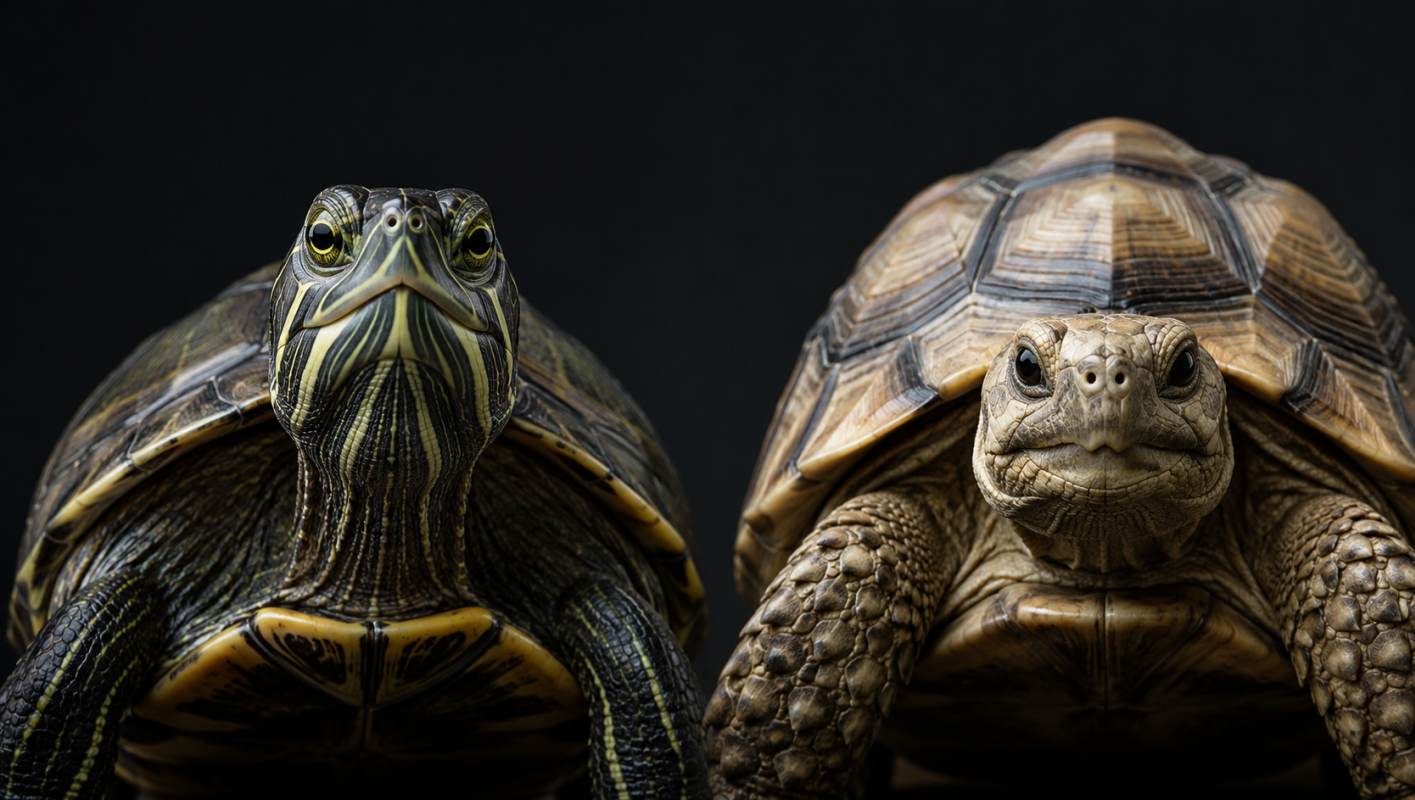
At first glance, turtles and tortoises seem almost identical. They both carry protective shells, move slowly compared to many other animals, and belong to the reptile order Testudines. Because of that, the two names are often used interchangeably.
But turtles and tortoises are adapted to very different lifestyles. One is built primarily for life in and around water, while the other is designed for a life on land. Their feet, shells, diets, and habitats all reveal important differences.
Quick Comparison
| Feature | Turtle | Tortoise |
|---|---|---|
| Habitat | Freshwater, marine, and coastal environments | Primarily land-based |
| Feet | Webbed feet or flippers for swimming | Thick, elephant-like feet for walking |
| Shell Shape | Flatter and more streamlined | Higher, more dome-shaped |
| Swimming Ability | Excellent swimmers | Poor swimmers |
| Diet | Varies widely; many species are omnivores | Mostly herbivorous |
| Lifespan | Often decades | Frequently exceeds 50 years, with some over 100 |
| Movement | Faster in water | Better adapted for walking on land |
The Biggest Difference: Where They Live
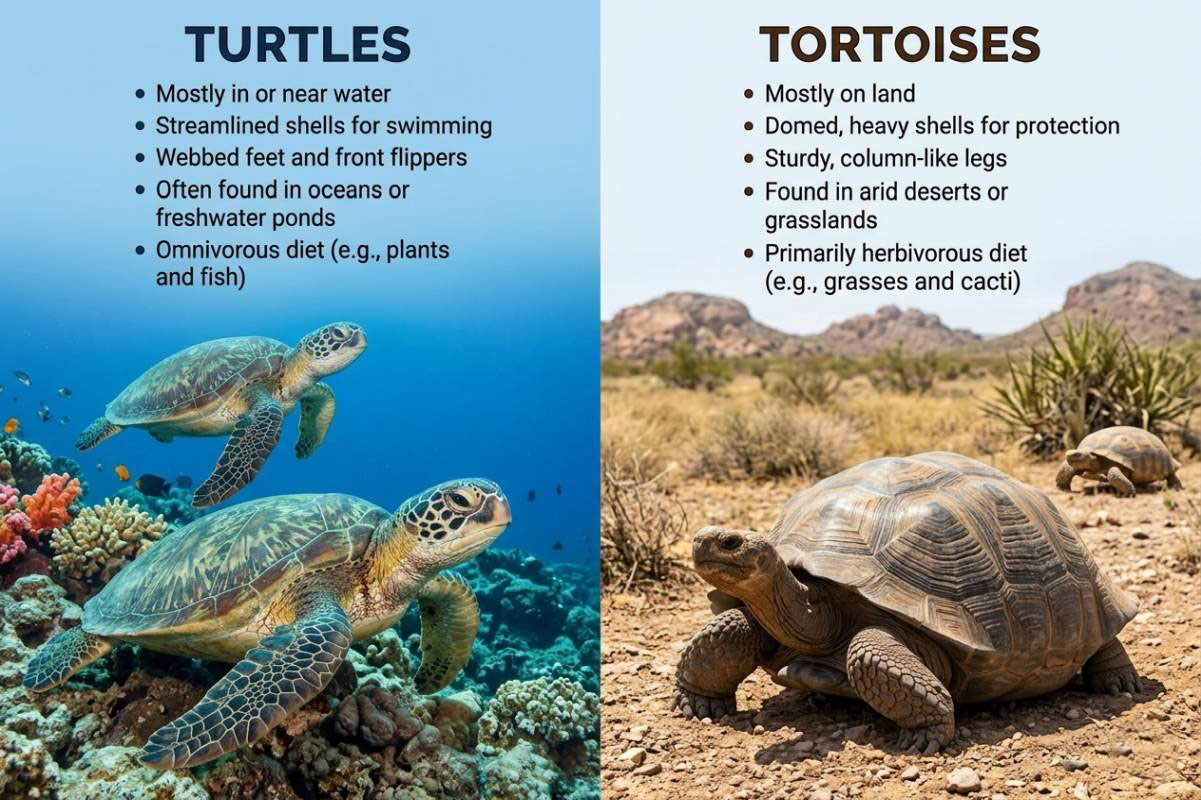
The easiest way to distinguish a turtle from a tortoise is by looking at its habitat.
Most turtles spend a significant portion of their lives in water. Depending on the species, they may live in oceans, rivers, lakes, marshes, or ponds. Even freshwater turtles are usually strong swimmers and only come onto land for basking, nesting, or resting.
Tortoises, on the other hand, are almost entirely terrestrial. They live in grasslands, deserts, scrublands, and forests, rarely entering deep water. Their bodies are designed for walking rather than swimming.
Feet Tell the Story
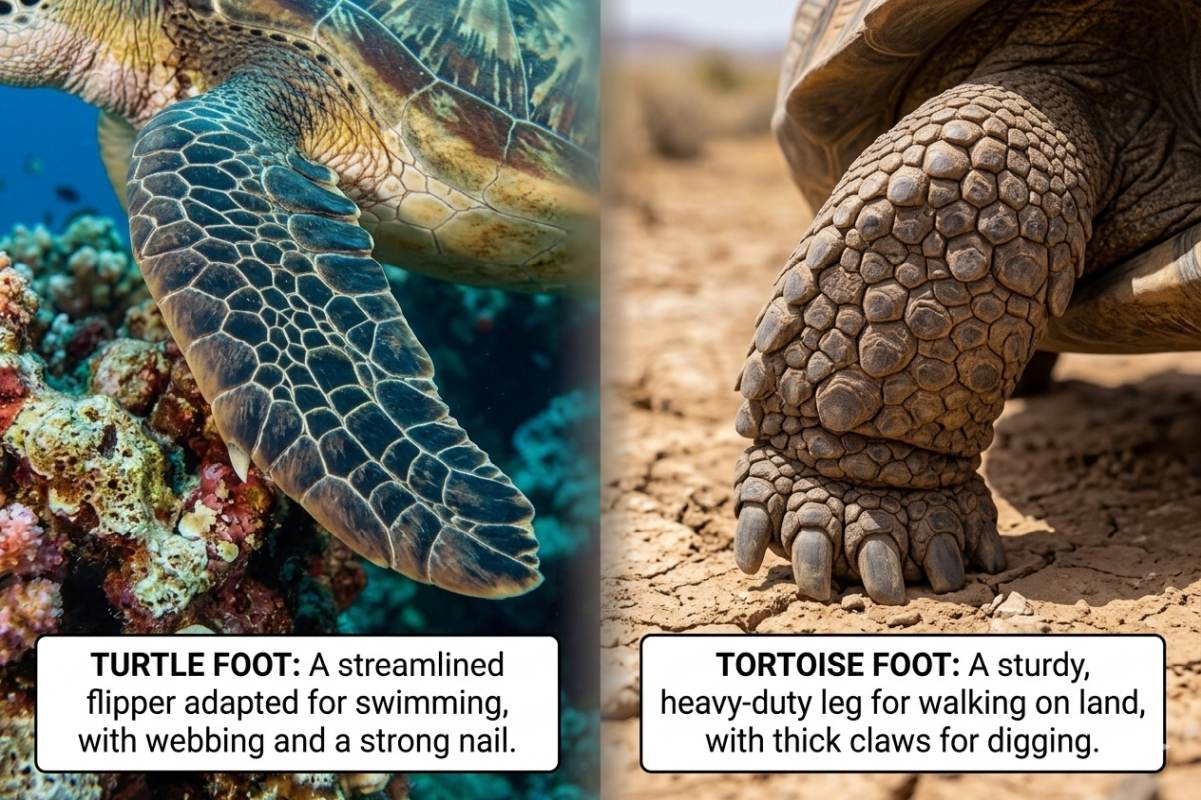
If you’re trying to identify one quickly, look at the feet.
Turtle Feet
- Webbed feet or powerful flippers
- Adapted for propulsion in water
- Often flattened and streamlined
Tortoise Feet
- Thick, sturdy legs
- Broad feet that resemble those of an elephant
- Built to support weight on land and dig burrows
A sea turtle’s flippers make it obvious that it belongs in the water, while a tortoise’s heavy legs make it clear that it’s a land specialist.
Shell Shape: Streamlined vs Armored
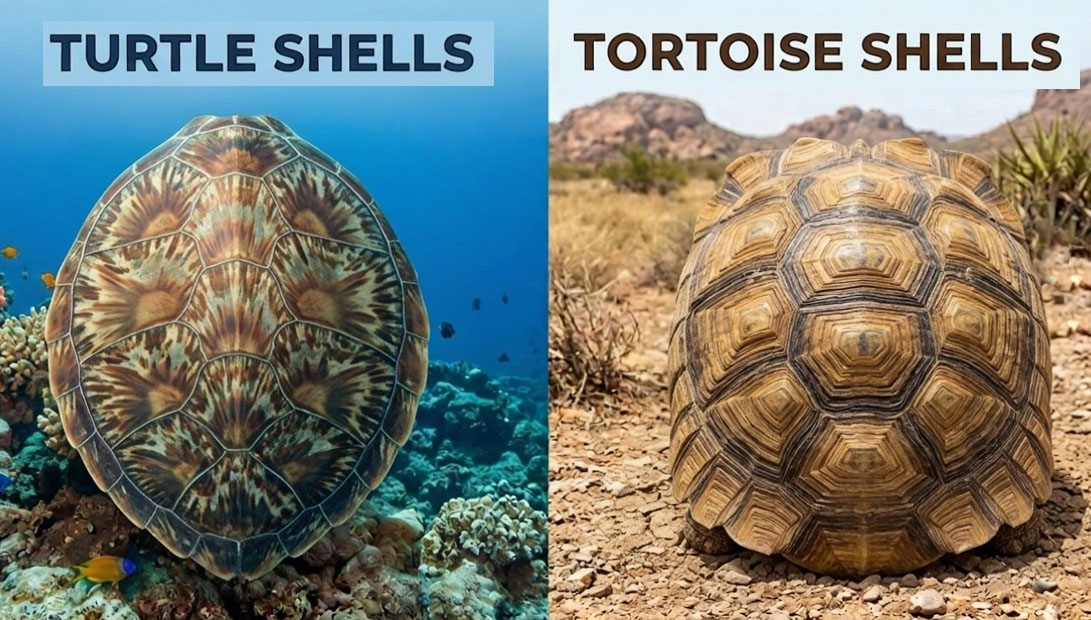
Their shells reflect their lifestyles.
Turtle Shells
Turtles generally have flatter, lighter shells that create less resistance in water. This streamlined shape helps them swim efficiently.
Tortoise Shells
Tortoises typically possess taller, dome-shaped shells. The rounded structure provides excellent protection from predators and suits a slow-moving terrestrial life.
Diet Differences
Many turtles are opportunistic feeders.
Depending on the species, they may eat:
- Aquatic plants
- Insects
- Fish
- Crustaceans
- Jellyfish
- Carrion
Tortoises are generally much more plant-focused. Their diets often consist of:
- Grasses
- Leaves
- Flowers
- Succulents
- Fruits
Because of these differences, tortoises often have stronger jaws designed for grinding vegetation.
Can Tortoises Swim?
This is one of the most common misconceptions.
While turtles are usually excellent swimmers, tortoises are not built for swimming. Their heavy shells and stout legs make moving through water difficult, and deep water can be dangerous for them.
A tortoise may wade through shallow water, but it should never be assumed that it can swim like a turtle.
Lifespan
Both groups can live surprisingly long lives.
Many turtle species live for several decades, but tortoises are famous for their longevity. Some species regularly exceed 80–100 years, making them among the longest-lived vertebrates on Earth.
Why People Confuse Them
The confusion comes from taxonomy.
Both turtles and tortoises belong to the order Testudines, meaning they share a common evolutionary ancestry and many physical characteristics. In everyday conversation, people often use “turtle” as a catch-all term for shelled reptiles.
Scientifically, however, tortoises are a distinct group specialized for terrestrial life, while turtles generally refer to species that spend much of their lives in water.
How to Tell Them Apart in Seconds
Use this simple rule:
If it has flippers or webbed feet and spends most of its time in water, it’s a turtle.
If it has sturdy, elephant-like legs and lives on land, it’s a tortoise.
Once you look at the feet, the difference becomes surprisingly obvious.
Final Verdict
Turtles and tortoises may share shells and ancient ancestry, but they evolved for very different environments. Turtles are aquatic specialists built for swimming, while tortoises are terrestrial wanderers designed for life on land. Their feet, shells, diets, and habitats all reflect that distinction.
The next time you spot a shelled reptile, a quick glance at its legs will usually tell you exactly which one you’re looking at.