
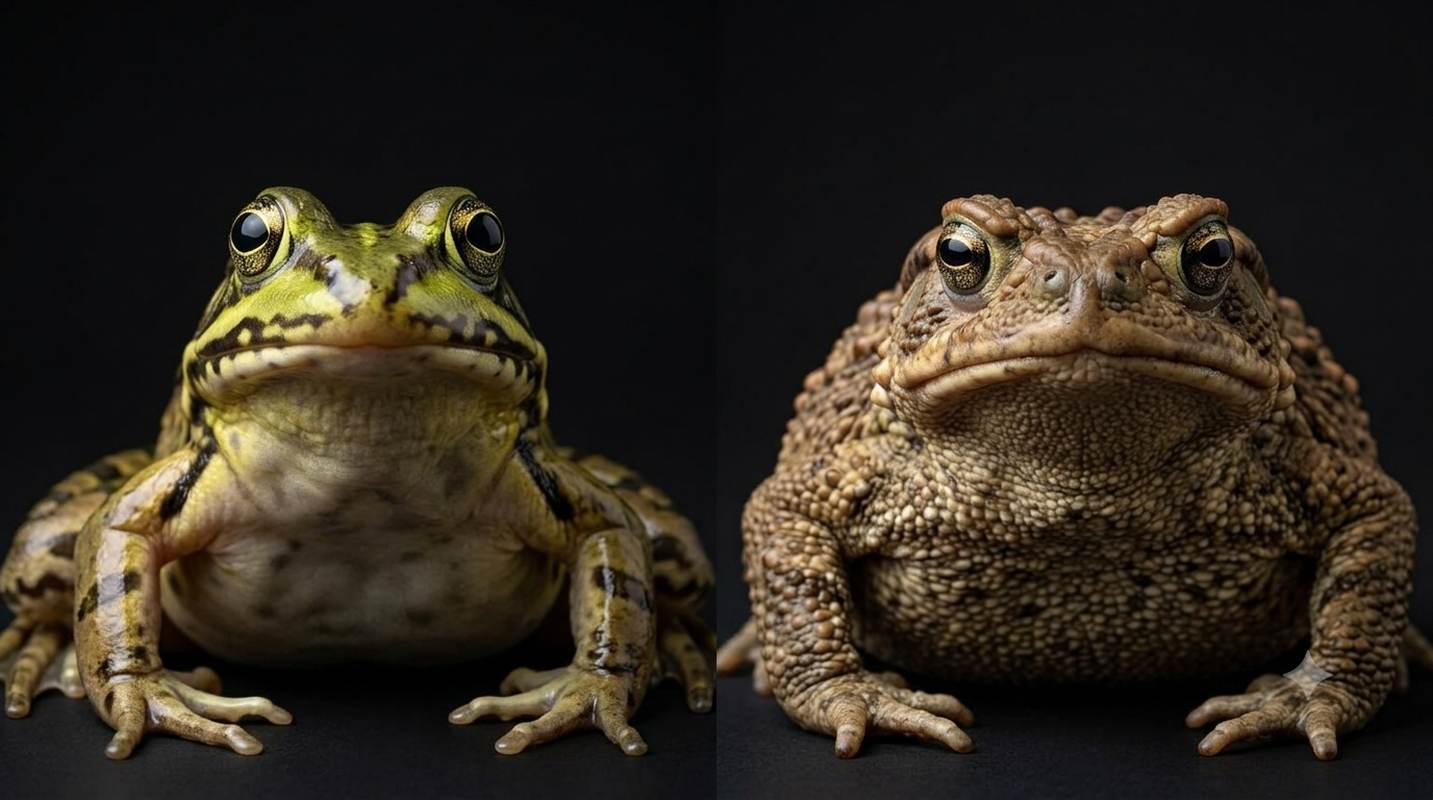
Frog vs Toad: What’s the Difference?
At first glance, frogs and toads seem almost identical. They both are tailless amphibians, move with powerful jumps, and belong to the order Anura. Because of that, the two names are often used interchangeably.
But frogs and toads are adapted to very different lifestyles. One is built primarily for life in or near water, while the other is designed for a life on land. Their skin, body shapes, eggs, and habitats all reveal important differences.
Quick Comparison
| Feature | Frog | Toad |
| Habitat | Near water (ponds, streams) | Primarily land-based (gardens, forests) |
| Skin | Smooth, moist, and slimy | Dry, bumpy, and warty |
| Body Shape | Slender, athletic | Stout, thick-waisted |
| Legs | Long, strong for jumping | Shorter, adapted for crawling or short hops |
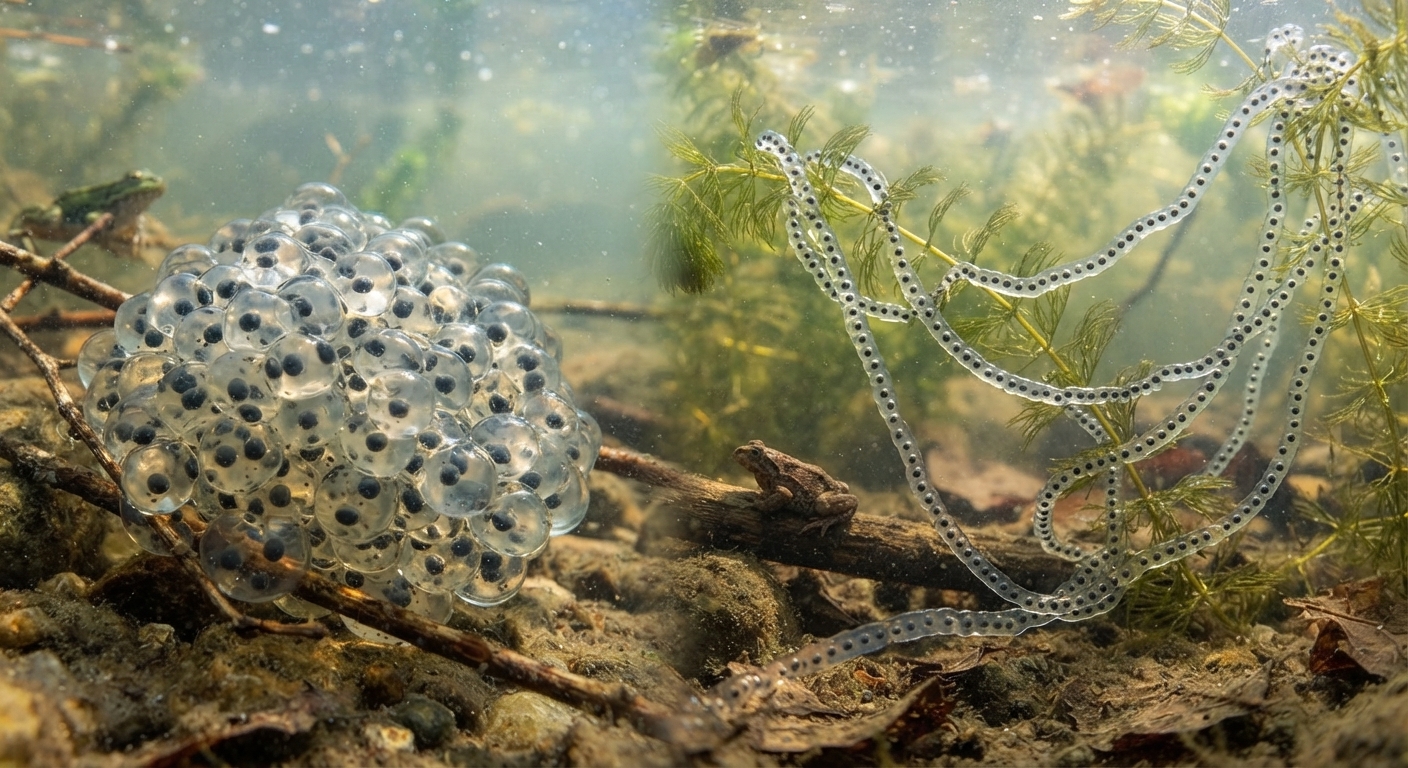
| Eggs | Laid in large clusters/clumps | Laid in long, continuous strings |
| Teeth | Usually present in the upper jaw | Generally toothless |
| Movement | Longer jumps/leaps | Shorter hops/crawling |
The Biggest Difference: Where They Live
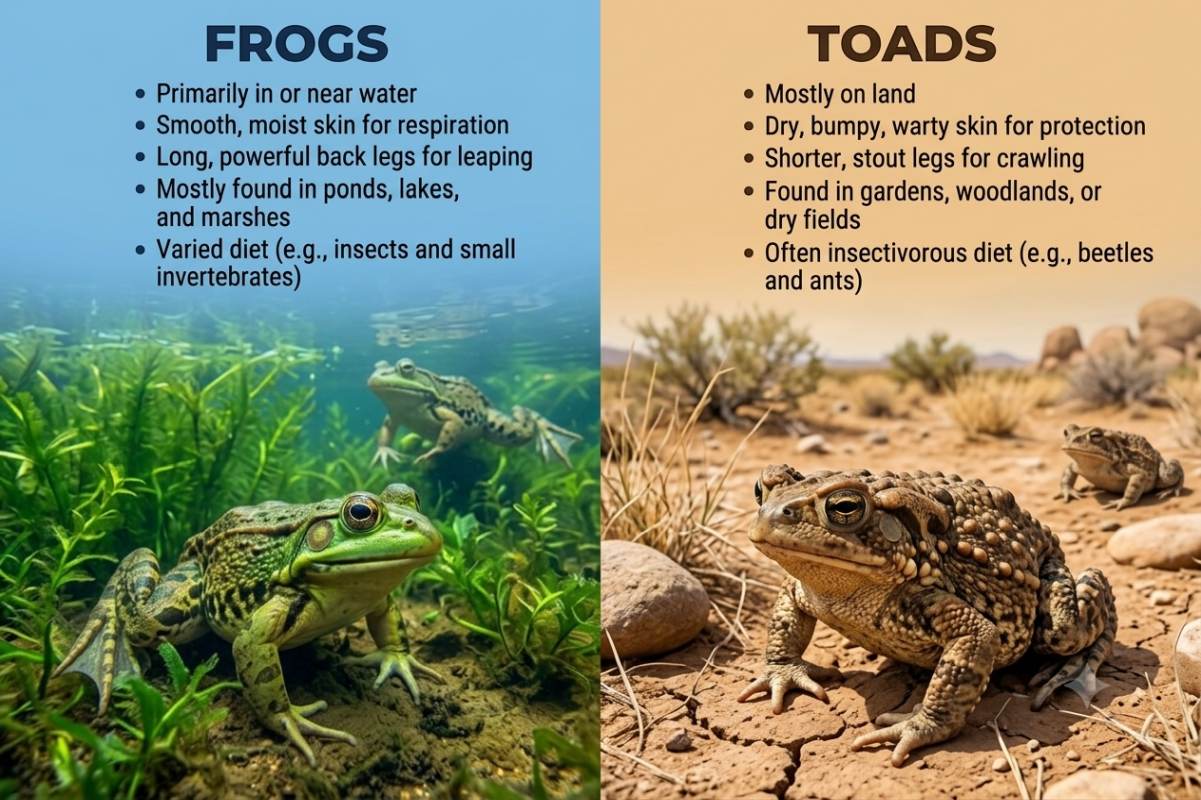
The easiest way to distinguish a frog from a toad is by looking at its habitat and skin.
Most frogs spend a significant portion of their lives in or near water. They rely on their moist skin to absorb oxygen and water, so they rarely stray far from damp environments like ponds, lakes, and streams.
Toads, on the other hand, are much more terrestrial. They live in gardens, woodlands, and arid areas. Their skin is thicker and drier, which helps them retain moisture, allowing them to thrive away from permanent water sources.
Skin Tells the Story
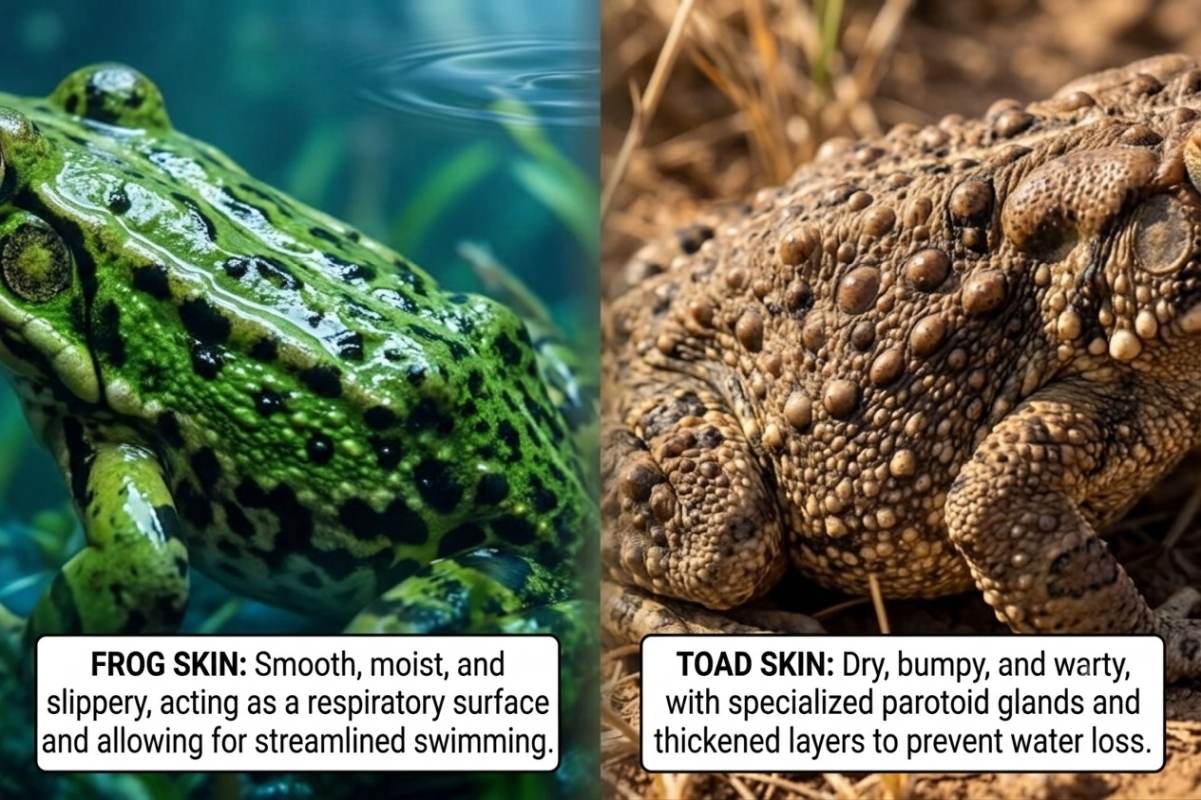
If you’re trying to identify one quickly, look at the texture of its skin.
Frog Skin
- Smooth and often slimy
- Must remain moist to function
- Usually bright or patterned to blend into wet environments
Toad Skin
- Dry and covered in bumps or “warts”
- Thickened to prevent water loss
- Often earth-toned (browns/grays) to camouflage in soil
A frog’s skin looks like it belongs in the water, while a toad’s skin is clearly designed to withstand the drier conditions of land.
Body Shape: Athletic vs Stout
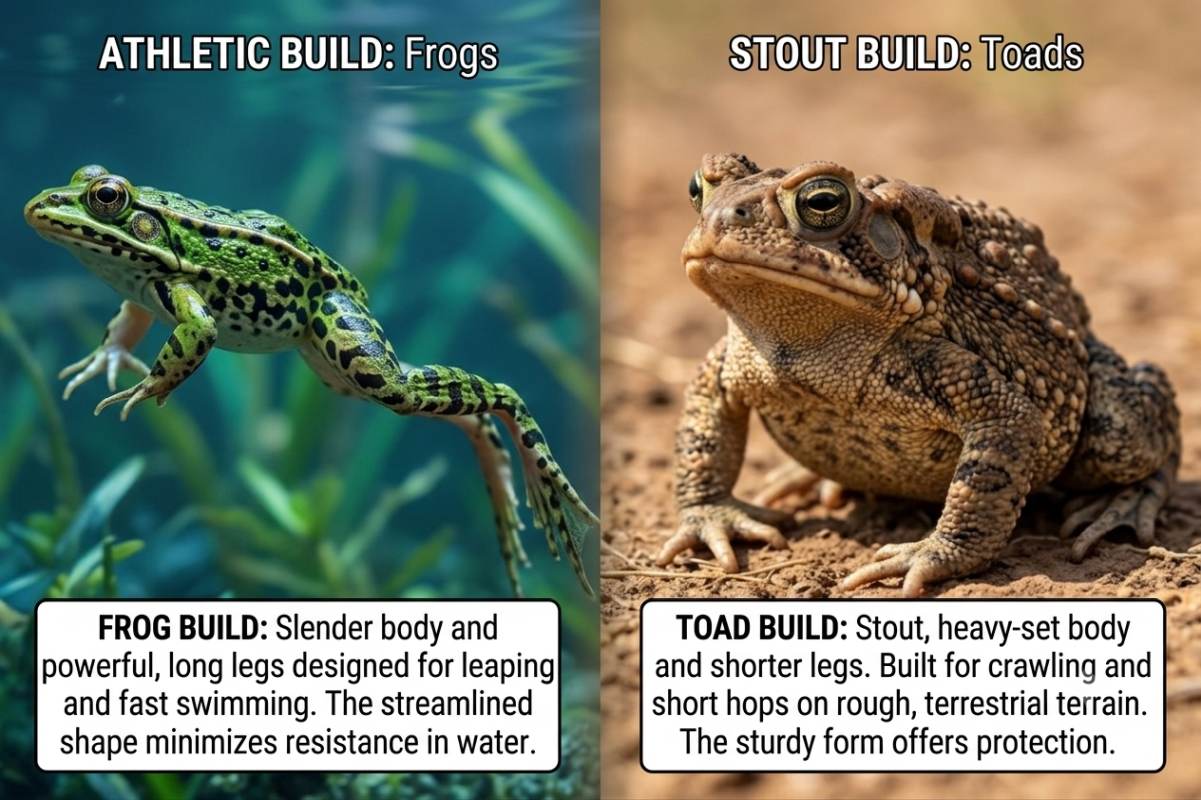
Their physical builds reflect their preferred methods of movement.
Frog Body
Frog’s generally have slender, athletic bodies with long, powerful legs. This build is perfect for taking long, impressive leaps to escape predators or catch prey.
Toad Body
Toads typically possess stouter, heavier bodies. Because they are not built for long-distance jumping, they spend most of their time crawling or taking short, awkward hops.
Egg Laying Habits
If you find eggs in the water, look at how they are arranged.
Frogs lay their eggs in large, globular clusters that look like a jelly-like mass. Toads, however, lay their eggs in long, elegant, continuous strings that often wrap around aquatic plants.
Are Toads Just “Dry” Frogs?
This is one of the most common misconceptions.
While all toads are technically frogs (they are part of the same order, Anura), not all frogs are toads. “Toad” is a common term used for certain species within the frog family that have adapted to live primarily on land. Think of a toad as a highly specialized type of frog that has evolved to move away from the water.
Why People Confuse Them
The confusion comes from their close biological relationship.
Both frogs and toads are amphibians, share a common evolutionary history, and go through similar life cycles—starting as aquatic tadpoles before transforming into adults. In everyday conversation, people often use “frog” as a catch-all term for any tailless amphibian.
Scientifically, however, the distinctions in their skin, legs, and habitat preferences are clear and reflect how each has adapted to its unique ecological niche.
How to Tell Them Apart in Seconds
Use this simple rule:
If it has smooth, moist skin and long legs for leaping, it’s a frog.
If it has dry, bumpy, warty skin and a stout body for crawling, it’s a toad.
Once you look at the skin texture, the difference becomes surprisingly obvious.
Final Verdict
Frogs and toads may share a common ancestry and a complex life cycle, but they evolved for very different environments. Frogs are water-loving athletes built for leaping, while toads are land-dwelling survivors designed for drier habitats. Their skin, bodies, and behaviors all reflect that distinction.
The next time you spot an amphibian in your yard or by a pond, a quick glance at its skin will usually tell you exactly which one you’re looking at.